
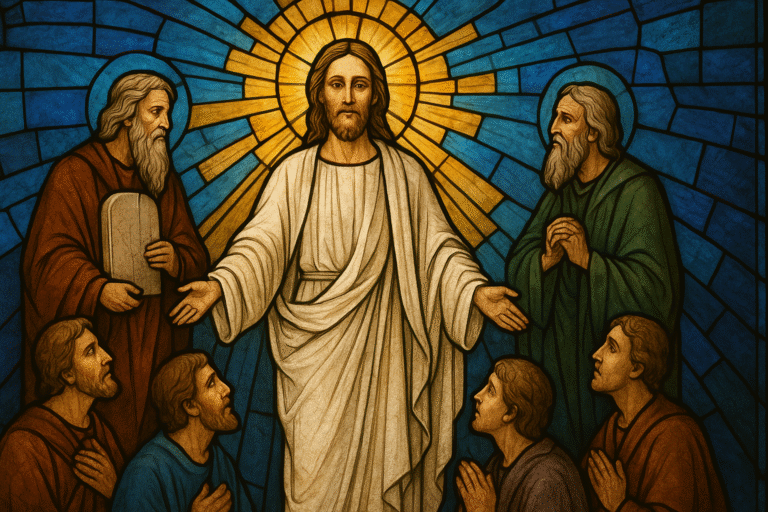
The Transfiguration of Jesus is one of the most profound moments recorded in the Gospels, a scene in which the veil of Christ’s humanity is briefly lifted, revealing His divine glory. Taking place on a mountain in the presence of three chosen disciples, the event brings together the Law, the Prophets, and the Messiah in a single, radiant vision.
Before we explore the details, here’s a quick overview of the event for context:
Quick Facts: The Transfiguration of Jesus
- Event Description: Jesus’ appearance was miraculously changed, revealing His divine glory before Peter, James, and John.
- Biblical References: Matthew 17:1–9, Mark 9:2–8, Luke 9:28–36, 2 Peter 1:16–18.
- Date in Jesus’ Ministry: Shortly after Peter’s confession of Christ as the Messiah (Matthew 16:16).
- Location (Traditional): Mount Tabor in Galilee; alternative suggestion: Mount Hermon.
- Participants: Jesus, Peter, James, John, Moses, Elijah, and the voice of God from the cloud.
- Main Purpose: To reveal Jesus’ divine nature, confirm Him as the fulfillment of the Law and the Prophets, and strengthen the disciples before His crucifixion.
- Christian Feast Day: August 6 (celebrated in Eastern Orthodox, Catholic, Anglican, and some Protestant traditions).
Christians have reflected on this moment for centuries, finding in it reassurance about who Jesus truly is, confirmation of His mission, and hope for the glory to come. Understanding the Transfiguration requires looking closely at its biblical accounts, its theological significance, and its continuing meaning for believers today.
What Does “Transfiguration” Mean?
The English word transfiguration comes from the Latin transfigurare, meaning “to change in shape or form.” In the Greek of the New Testament, the word used is μεταμορφόω (metamorphoō), which also means “to transform” or “to change in appearance” (Matthew 17:2; Mark 9:2).
In everyday speech, transformation often refers to a change in character or inner qualities. In this context, however, it describes a visible and supernatural change in Jesus’ appearance. A revelation of His divine majesty rather than a change in His nature. Jesus was always the Son of God; at the Transfiguration, that truth became visible in a unique and unforgettable way.
The Biblical Account of the Transfiguration
The Transfiguration is recorded in three Gospels, Matthew 17:1–9, Mark 9:2–8, and Luke 9:28–36, and briefly referenced by the apostle Peter in 2 Peter 1:16–18.
According to Matthew and Mark, the event took place “after six days” from Peter’s confession that Jesus is the Messiah (Matthew 16:16; Mark 8:29). Luke’s account notes “about eight days” later (Luke 9:28), possibly counting inclusively. Jesus took Peter, James, and John with Him up a “high mountain” to pray.
While Jesus was praying, “the appearance of His face changed, and His clothes became as bright as a flash of lightning” (Luke 9:29). Matthew adds that “His face shone like the sun, and His clothes became white as the light” (Matthew 17:2). This dazzling transformation was accompanied by the sudden appearance of two men, Moses and Elijah, who “spoke about His departure, which He was about to bring to fulfillment at Jerusalem” (Luke 9:31).
As Peter, overwhelmed, suggested building shelters for the three figures, a bright cloud overshadowed them. From the cloud came a voice: “This is my Son, whom I love; with Him I am well pleased. Listen to Him!” (Matthew 17:5). When the disciples heard this, they fell facedown in fear, but Jesus touched them and told them not to be afraid. When they looked up, they saw only Him.
Why Moses and Elijah Appeared
The presence of Moses and Elijah is rich in symbolism. Moses, the great lawgiver, represents the Law given at Mount Sinai (Exodus 19–24). Elijah, the prophet taken into heaven without dying (2 Kings 2:11), represents the prophetic tradition that pointed forward to the Messiah.
Together, they stand for the Law and the Prophets, the two great divisions of the Hebrew Scriptures, bearing witness to Jesus as their fulfillment (Luke 24:27). Their conversation with Jesus about His “departure” (literally “exodus” in Greek) connects His coming death and resurrection with God’s plan of redemption that began with Israel’s deliverance from Egypt.
The Significance of the Transfiguration
The Transfiguration is not merely a supernatural display; it serves a specific purpose in the story of salvation. It provides a foretaste of Christ’s resurrection glory before the suffering of the cross, strengthening the faith of His disciples. By placing it after Peter’s confession and Jesus’ first clear prediction of His death (Matthew 16:21), the Gospel writers show that the glory of Christ and the suffering of the cross are inseparable.
The voice from the cloud, echoing God’s words at Jesus’ baptism (Matthew 3:17), confirms His divine Sonship and commands obedience: “Listen to Him!” This is more than an instruction to the disciples. It is a command to all who would follow Christ.
For believers today, the Transfiguration is a reminder that Jesus is not merely a moral teacher or a prophet. He is the eternal Son of God, worthy of worship and obedience. It also offers hope that those who follow Him will one day share in His glory (Philippians 3:20–21).
Where Did the Transfiguration Take Place?
The Gospels do not name the mountain, leading to centuries of debate. Tradition, dating back at least to the fourth century, identifies Mount Tabor in Galilee as the site. Pilgrims visiting the Holy Land often climb this hill, which now holds churches commemorating the event.
However, some scholars suggest Mount Hermon, located near Caesarea Philippi, because it is closer to where the preceding events in the Gospels occurred (Matthew 16:13). The truth is that the exact location remains uncertain (and perhaps intentionally so) reminding us that the meaning of the event matters more than the geography.
The Transfiguration in Christian Worship
The Feast of the Transfiguration is celebrated on August 6 in Eastern Orthodox, Roman Catholic, and some Anglican and Protestant traditions. The liturgy typically includes the Gospel accounts, hymns exalting Christ’s glory, and reflections on the event’s meaning. In the Eastern Orthodox tradition, the feast is also linked with the blessing of the first fruits of the harvest, symbolizing the spiritual fruit of God’s work in the world.
Further Reading: Books on the Transfiguration
For those wishing to study the Transfiguration more deeply whether in its biblical, theological, or devotional dimensions, these works are a strong starting point:
- The Glory of Christ by R.C. Sproul – A readable yet profound meditation on Christ’s majesty, with a section on the Transfiguration.
- Jesus: The God-Man by Bruce A. Ware – Explores the union of Jesus’ divine and human natures, helping explain the significance of His revealed glory.
- The Transfiguration of Christ by St. Thomas Aquinas – A theological classic offering insights from medieval Christian thought.
- Jesus of Nazareth: From the Baptism in the Jordan to the Transfiguration by Pope Benedict XVI – A scholarly yet devotional look at Jesus’ life and ministry, culminating in the Transfiguration.
Frequently Asked Questions
What is the purpose of the Transfiguration?
It reveals Jesus’ divine nature, confirms Him as the fulfillment of the Law and the Prophets, and prepares the disciples for His coming death and resurrection (Matthew 17:1–9; Mark 9:2–8; Luke 9:28–36).
Why did only Peter, James, and John witness it?
They were part of Jesus’ closest inner circle (Mark 5:37; Matthew 26:37) and would later serve as key witnesses to His glory (2 Peter 1:16–18).
Does the Transfiguration appear in all four Gospels?
It appears in Matthew, Mark, and Luke, with John alluding to it indirectly when he writes, “We have seen His glory” (John 1:14).
The Transfiguration is more than a passing miracle, it is a moment when heaven and earth meet, when the glory of the Son of God shines openly before human eyes. It is a turning point in the Gospel story, bridging the revelation of Christ’s identity with the path toward His suffering, death, and resurrection.
For modern believers, it remains a call to “listen to Him,” to trust in His promises, and to live in anticipation of the day when His glory will fill the earth.
Key Takeaways on the Transfiguration
The Transfiguration is not simply a dazzling moment in the Gospels it is a window into eternity. In this event, Jesus’ divine glory breaks through His earthly appearance, affirming His identity as the Son of God. Moses and Elijah stand beside Him, showing that all of Scripture (the Law and the Prophets) points to Christ.
For the disciples, it was a faith-strengthening preview of the resurrection to come. For believers today, it is a call to listen to Jesus above all voices, to trust His promises even in seasons of trial, and to live in the hope that one day His glory will fill the earth.