
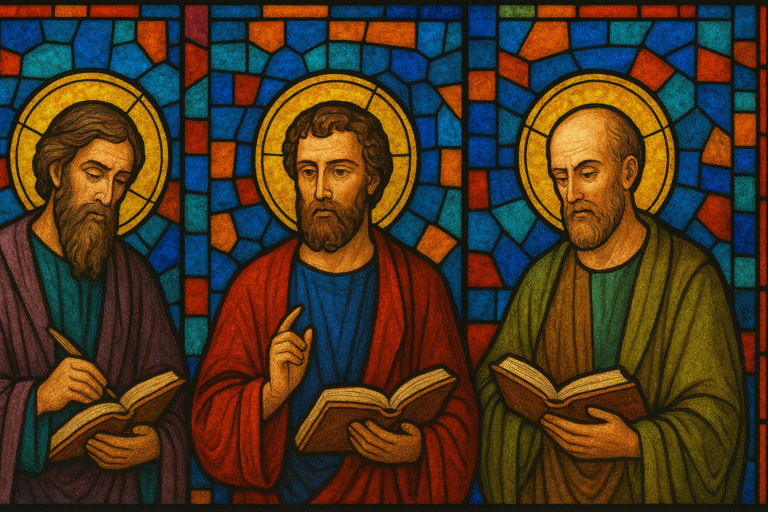
When reading the New Testament, you may notice that three of the Gospels (Matthew, Mark, and Luke) tell the story of Jesus in a remarkably similar way. These are called the Synoptic Gospels, a term used in biblical studies to describe their shared perspective, content, and order. Understanding what “synoptic” means, why these books are grouped together, and how they differ from the Gospel of John can give you a much deeper appreciation for how the Bible is written and why it is structured the way it is.
What Does “Synoptic Gospel” Mean?
The word synoptic comes from the Greek words syn (“together”) and opsis (“view”). Literally, it means “seeing together” or “viewing together.” Scholars use this term because Matthew, Mark, and Luke present the story of Jesus from a shared viewpoint, often recounting the same events, in the same order, and sometimes using similar or even identical wording.
This similarity is not accidental. These three Gospels cover much of the same ground: Jesus’ baptism, His parables, His miracles, His death and resurrection, often with overlapping details. While each writer shapes the narrative for a particular audience and purpose, the common material is what makes them “synoptic.”
The resemblance among the three raises an important scholarly question known as the Synoptic Problem: Why are these accounts so much alike, and what does that tell us about their sources? This has been a major topic of study for centuries.
Which Books Are the Synoptic Gospels?
Matthew
Traditionally thought to have been written for a primarily Jewish audience, Matthew emphasizes how Jesus fulfills Old Testament prophecies. The Gospel is filled with references to Hebrew Scripture, showing that Jesus is the long-awaited Messiah. Matthew also presents Jesus as a teacher like Moses, delivering the famous Sermon on the Mount and organizing much of His teaching into clear sections.
Mark
Mark is generally considered the earliest Gospel, and it’s the shortest. Its pace is brisk, moving quickly from one event to another. Mark spends less time on long speeches and more on Jesus’ actions, His miracles, encounters with people, and journey to the cross. The style is direct and vivid, sometimes reading almost like an eyewitness account.
Luke
Luke, a physician and companion of the Apostle Paul, offers the most detailed and orderly narrative. His Gospel is addressed to “Theophilus” and is often considered to have been written for a Gentile (non-Jewish) audience. Luke shows special concern for the marginalized (women, the poor, and outsiders) and he includes parables not found in the other Gospels, such as the Good Samaritan and the Prodigal Son. His writing style is polished and historical, suggesting careful research and attention to detail.
The Gospel That Is Not Synoptic: John
The Gospel of John stands apart from the Synoptics in several ways. While it covers many of the same major events (such as Jesus’ miracles, His crucifixion, and His resurrection) it presents them differently. John is more reflective and theological, offering longer discourses by Jesus and emphasizing His divine nature from the very beginning: “In the beginning was the Word, and the Word was with God, and the Word was God” (John 1:1).
John often includes material the Synoptics do not: the wedding at Cana, the raising of Lazarus, extended teaching in the Upper Room, and the “I Am” statements (such as “I am the bread of life” and “I am the light of the world”). Instead of many short parables, John focuses on deep conversations and symbolic acts that reveal who Jesus is.
How the Synoptic Gospels Compare to John
While all four Gospels tell the story of Jesus, the Synoptics and John differ in several important ways:
- Narrative Similarity: The Synoptic Gospels share a common outline and often describe the same events in a similar order. John follows a different structure, placing events in a different sequence and including unique material.
- Teaching Style: The Synoptics contain many short parables and sayings of Jesus. John, on the other hand, records long, theological discourses and dialogues.
- Focus: The Synoptics frequently refer to the “Kingdom of God” as a central theme. John focuses heavily on Jesus’ identity as the eternal Son of God and uses symbolic language to explain His mission.
- Tone and Purpose: The Synoptics feel more narrative-driven, recounting what Jesus did and taught. John feels more interpretive, showing the meaning behind His actions.
Why the Synoptic Gospels Matter
The Synoptic Gospels provide a rich, multi-angled view of Jesus’ life and ministry. Because they often recount the same events from slightly different perspectives, reading them together helps fill in details and clarify meaning. For example, one Gospel might give a brief version of an event while another includes more dialogue or background.
For historians, the overlap among the Synoptics strengthens the case for the reliability of the accounts. For students of the Bible, these Gospels help build a fuller, more grounded understanding of who Jesus is and what He taught.
The Synoptic Problem – A Scholarly Puzzle
The Synoptic Problem is the study of how Matthew, Mark, and Luke are related in terms of sources and writing order. Scholars have proposed several theories:
- Markan Priority: The view that Mark was written first, and Matthew and Luke used Mark as a primary source, adding their own material.
- Two-Source Hypothesis: A variation of Markan Priority that suggests Matthew and Luke also drew from a lost written source called “Q” (from the German word for “source,” Quelle), which may have contained sayings of Jesus.
- Other Theories: Some suggest all three drew from a mix of oral traditions and smaller written collections of Jesus’ teachings.
While there is no single agreed-upon solution, most scholars believe the similarities among the Synoptics point to some form of shared source material.
Common Questions About the Synoptic Gospels
Why are they called “synoptic”?
Because they present the life of Jesus from a “common view,” sharing much of the same material.
Did the writers copy each other?
Not necessarily in the sense of plagiarism, but they may have used shared sources (whether written documents or oral traditions) while still shaping their accounts for different audiences.
Which Gospel was written first?
Most modern scholars believe Mark came first, though some argue for Matthew.
Should I read them in order?
You can, but many readers benefit from reading them side-by-side or in a “harmony of the Gospels” format, which lines up parallel passages.
Conclusion
The Synoptic Gospels, Matthew, Mark, and Luke, give us a unified yet diverse portrait of Jesus. Their shared perspective allows us to see the same events from slightly different angles, enriching our understanding. The Gospel of John, while telling the same overarching story, offers a complementary and deeply theological viewpoint.
By reading all four Gospels together, you experience both the narrative depth of the Synoptics and the theological insight of John; together providing a more complete picture of Jesus’ life, ministry, and significance.